Why Nestbalm has no bank connection
Diesen Artikel auf Deutsch lesen
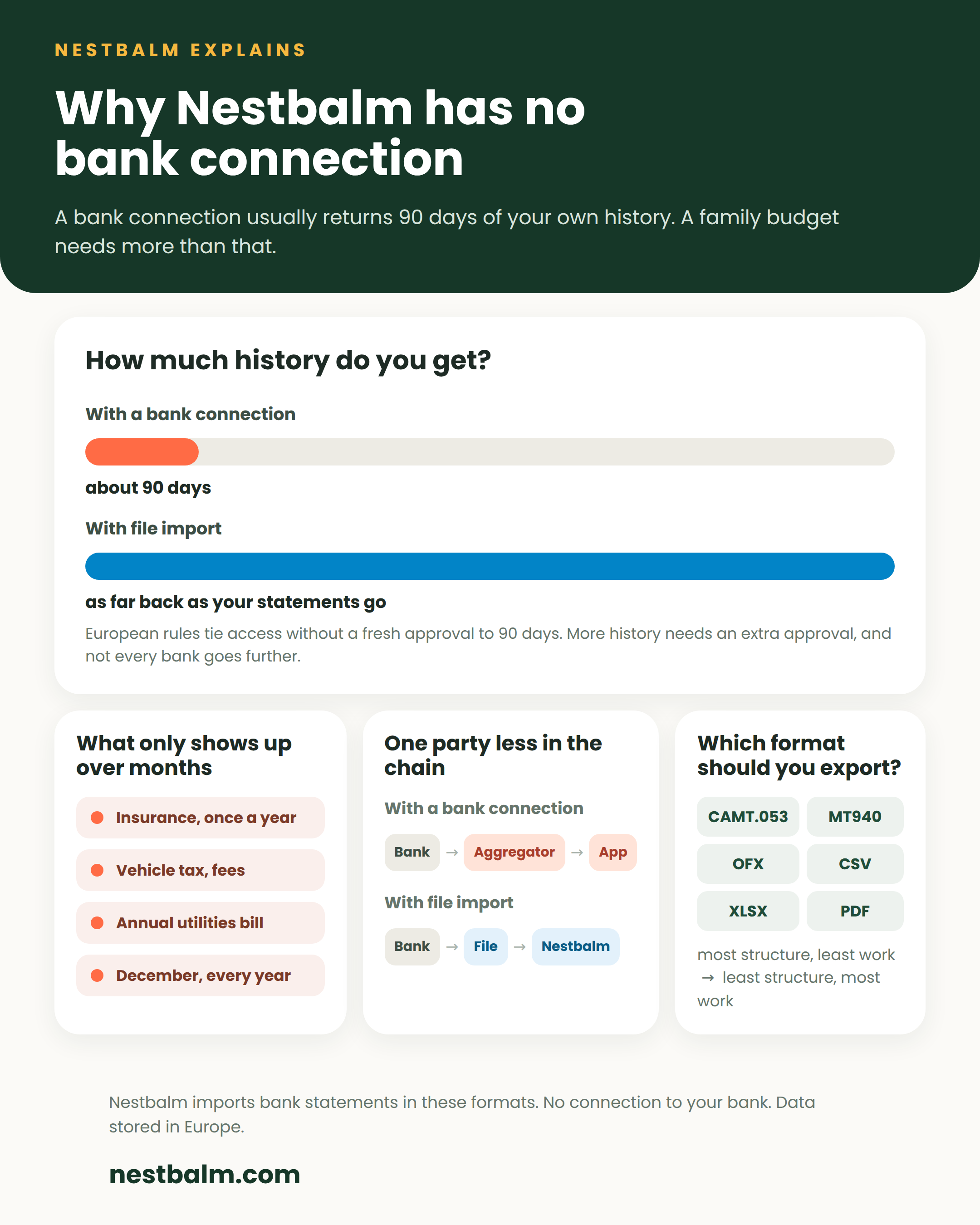
Because in most cases a bank connection gives you back only 90 days of your own history. Ninety days is not enough to understand a family budget.
What a bank connection actually delivers
When an app connects to your account, it pulls transactions through your bank’s interface. In practice there is a limit: many banks return the last 90 days on the first fetch. Going further back needs an extra approval, usually with a TAN, and even then how far back you get depends on the individual bank.
Those 90 days are not arbitrary. The European rules on strong customer authentication tie the exemption from re-authentication to exactly that window: an app may show the balance and the transactions of the last 90 days without a fresh login. Anything older is a matter of negotiation between app, aggregator and bank.
For a live view of spending that is enough. For a budget it is not.
Why a longer history changes the answer
A family budget is not made of what happened this week. It is made of what comes back every year:
- insurance premiums paid once a year
- vehicle tax, broadcasting fee, memberships
- the annual utilities and heating settlement
- school supplies in summer, presents in December
- subscriptions that went up in spring and have run quietly ever since
Three months of data show almost none of this. Two or three years show the pattern: which items repeat, how much they move, and which month of the year is reliably the expensive one. Those are exactly the items that later arrive as an unpleasant surprise.
With file import you decide how far back the history goes. You export what your bank offers, and you add the statements you have already archived. Some households start with three months, others with five years. Both work, and the second gives better answers.
One party less in the chain
The second reason is less dramatic, and it still counts.
A bank connection is a regulated service in Europe. Whoever fetches account data on your behalf needs a licence as an account information service provider, in Germany from BaFin. In practice almost nobody buys that capability outright; they use an aggregator. So between your bank and the app you actually wanted to use sits another company that sees your transactions.
File import has no such chain. There is no standing connection to your account, no stored bank credentials and no third company in the data path. You upload a file, and nothing else happens.
Which format should you export?
Most banks offer several. They differ mainly in how much structure survives.
CAMT.053 is today’s standard for account statements in European payments. XML, highly structured, with clean separate fields for amount, date, counterparty and reference. If your bank offers it, take it.
MT940 is the older standard that many banks still provide. Fewer fields than CAMT, but reliable and widespread.
OFX and QFX come from the personal finance software world and also carry transactions in structured form. Less common in German-speaking markets, more common elsewhere.
CSV is the pragmatic case. Almost every bank can produce it, and every bank does it differently: different column names, date formats and separators. It works, it just needs more interpretation.
XLSX behaves like CSV, in a spreadsheet file.
PDF is the classic statement. It is made to be read, not to be analysed. The numbers have to be read back out, which works but is the most laborious route. PDF is most useful for old statements that exist in no other format.
Rule of thumb: if your bank offers CAMT.053, take it. Otherwise MT940 or CSV. Use PDF for the past that you cannot get any other way.
What Nestbalm reads today
Nestbalm imports bank statement files in OFX, CAMT.053, MT940, CSV, XLSX and PDF format. There is no connection to your bank. Data is stored in Europe.
Nestbalm does not hold money and does not move money. It works with the information about your transactions, not with your account.
And later?
A bank connection is not ruled out. If enough households ask for it, we will build it in addition, not as a replacement. File import stays either way, because it does the thing a connection cannot: the whole history, not the last 90 days.
Sources
- EBA Q&A on the SCA exemption for account access (90 days): https://www.eba.europa.eu/single-rule-book-qa/qna/view/publicId/2023_6833
- Verbraucherzentrale Niedersachsen on PSD2 third party providers: https://www.verbraucherzentrale-niedersachsen.de/themen/finanzen/banken-zahlungsverkehr/psd-2-drittanbieter-koennen-zugriff-auf-konten-erhalten
- StarMoney help centre on fetching transactions older than 90 days: https://hilfe.starmoney.de/hc/de/articles/360018750993
We created an app that helps people plan expenses, track them with visual tools, and avoid unpleasant surprises from unexpected (forgotten) spending. Families can use it to educate their kids on what money is and how to use it.